Adobe-style desert homes lit by warm outdoor lighting at dusk, with saguaro cacti in the foreground and a rocky mountain range behind them.

Furnace Repair in Caliente, NV

Tell us about the job

Takes about a minute. No obligation.

RepairFurnace or heatingLincoln County, NV
Step 1 of 2

What ZIP code is the job in?

September is the month to catch problems early

Furnaces in Caliente sit idle most of the year and start up again in October. A part that's been weakening since spring usually doesn't show it until the furnace has to run hard, and that first real cold snap is when it gives out.

An October breakdown is often an old problem, not a new one

If your furnace quit in the first weeks of the season, the cause was probably already there before you turned it on. Getting it looked at now means fixing what's actually wrong instead of just getting heat back for one night.

8 months
October through May, your furnace is on duty
27°F
the average winter night it heats against
7 winter storms
in ten years, the nights a failure hurts most
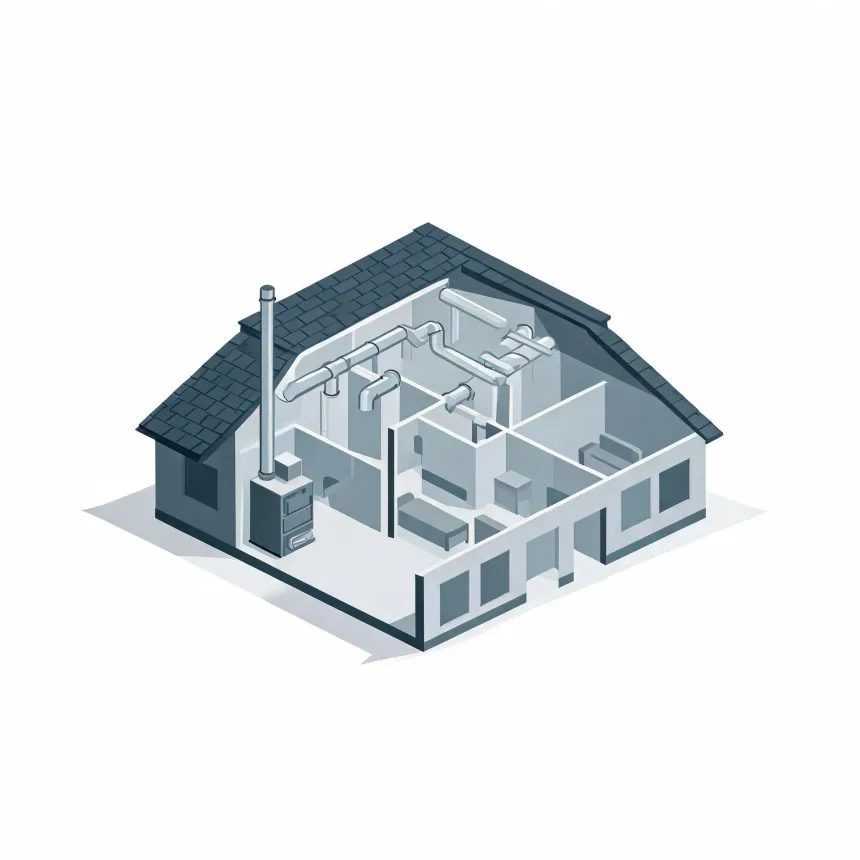
Isometric grayscale illustration of a cutaway house showing interior rooms, ceiling ductwork, a flue pipe, and a furnace unit on the left side.
Your furnace works hardest from November through March.

NOAA nClimDiv, 1991–2020 normals

A cracked heat exchanger means a new furnace, not a repair.

Almost everything else on a furnace, the igniter, the flame sensor, the blower motor, can be replaced on its own without touching the rest of the unit.

Electricity here runs $43.95 per million Btu, and this furnace will burn through plenty of it between October and May

Heat runs October through May
Winter nights average 27°F
Climate zone 4B
Nothing unusual here, just an old part giving outHalf the homes in Lincoln County were built in 1982 or earlier. Age of the house doesn't change what's wrong with the furnace.

A furnace that's short cycling, running loud, or struggling to hold a temperature isn't just annoying, it's pulling more power to do the same job. That cost shows up on the bill before it shows up as a full breakdown. Waiting until it quits means paying the higher rate the whole time it was failing, then paying for the repair anyway. A technician can check whether what's wrong is minor now, a dirty flame sensor or a weak capacitor, before it turns into something that runs the system hard every day it's ignored.

Get it looked at early

Problems tend to show up in the first weeks of the season, when the load hits a part that was already weak.

Find a contractor
A gas furnace with attached ductwork, gas piping, and condensate lines installed in a concrete-block basement.

Parts wear out from running, not from cold

Most furnace failures trace back to the same handful of parts, and they all wear out the same way. A little more each time the furnace runs. The igniter heats up and cools down every cycle until it gets brittle enough to crack. The flame sensor builds up a film from the burned gas until it can't tell the control board a flame is lit, so the furnace shuts itself off as a safety measure. The blower motor's bearings wear from spinning. A capacitor loses its charge a little at a time until it can't start the motor at all. None of this comes from one bad night of cold. It's the ordinary wear of running, the same as brake pads on a car. A furnace that runs hard gets through its parts faster than one that barely runs at all.

Check the simple things first

Make sure the thermostat is set to heat and set above room temperature, and check that it has power or fresh batteries. Check the breaker for the furnace and the switch that looks like a light switch on or near the unit itself, that's the furnace's power switch and it's easy to bump off. If you have a standing pilot, see if it's lit. None of this takes a tool, and it clears up more no-heat calls than people expect.

Know what to leave alone

Don't open the burner compartment or go near the gas valve. If you smell gas, don't flip switches or light anything, get out and call the gas company from outside. A furnace that's tripping its breaker repeatedly shouldn't be reset again and again, that's the furnace telling you something's wrong downstream. Checking the filter is fair game, a clogged one can cause the furnace to overheat and shut down on its own safety switch, and that's worth ruling out before anyone comes out.

A furnace that's struggling doesn't fail quietly, it fails harder the longer it's left alone. A cracked igniter that still barely lights will keep flexing with every cycle until it finally breaks apart. A flame sensor coated in film makes the furnace shut off more often, and each failed attempt to relight puts the same strain on the igniter and the control board. A blower motor running on worn bearings has to pull harder to spin at the same speed, and that extra draw is what burns the motor out for good. None of this fixes itself by running more. It gets worse on the same path it was already on, just faster, until the part that was limping gives out completely.

A diagnostic starts with the thermostat, not the furnace. A tech checks that the call for heat is actually reaching the control board before touching anything downstream. From there it's a sequence. Power to the unit, the igniter glowing or sparking, flame proving, the blower kicking in on schedule. Each step either happens or it doesn't, and wherever it stops is where the problem is. A furnace that lights and then shuts off is a different problem than one that never lights at all. The symptom narrows it down before a panel ever comes off. Most of the visit is watching the furnace go through a cycle and seeing exactly where it breaks the pattern.