






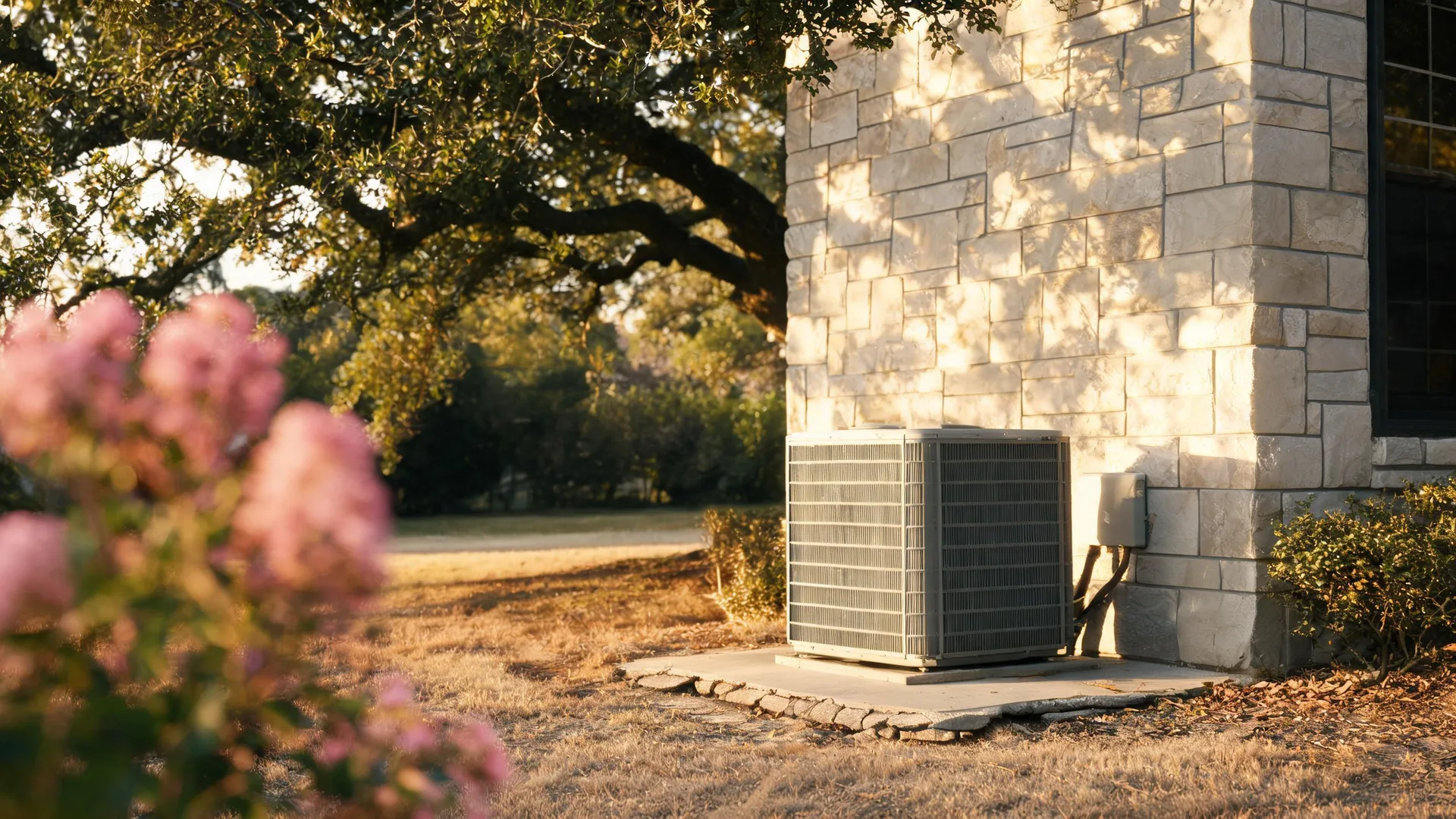
A gray outdoor HVAC condenser unit mounted on a concrete pad in the front yard of a two-story suburban house.

Heat Pump Repair in Caliente, NV

Tell us about the job

Takes about a minute. No obligation.

RepairHeat PumpLincoln County, NV
Step 1 of 2

What ZIP code is the job in?

Winter nights in Lincoln County average 27°F. That's cold, but it's not the kind of extreme a heat pump has to fight hard against night after night. A system here isn't working as hard as one in a place with harsher winters, so when something goes wrong, it's rarely because the unit has been run into the ground. More often it's a failed part or something that's drifted out of adjustment. That's usually worth fixing rather than replacing.

8 months
October through May, your system heats
4 months
June through September, it cools
27°F
the average winter night it heats against
90°F
the average summer afternoon it cools against
Isometric cutaway illustration of a single-story house showing interior rooms with ductwork, an indoor air handler unit, and an outdoor condenser unit connected by lines along the exterior wall.
Your system heats October through May and cools June through September.

NOAA nClimDiv, 1991–2020 normals

Heat pumps in Lincoln County run from October through May.

September is worth a look, since that's when a weak part gets found right before the system switches over.

An older home doesn't mean an older heat pump problem

Half the homes here were built by 1982
Winter nights average 27°F
Power costs 15 cents a kWh statewide
Electricity here isn't cheapNevada homes paid 15 cents per kilowatt-hour in 2024, so a heat pump running wrong costs you more every month it goes unfixed.

If a repair tech finds a heat pump here in decent shape mechanically, that tracks with what the winters ask of it at 27°F. A worn-out compressor at a young age is the exception, not what you'd expect. So when something goes wrong, get the actual cause checked before anyone talks about replacement. A stuck reversing valve, a failed capacitor, a thermostat that's lost its calibration, these are the kind of fixes that bring a system back to normal. Ask what failed and why first.

A heat pump running wrong adds up fast at 15 cents a kilowatt-hour

Get the cause diagnosed now instead of letting it run inefficiently through the months ahead.

Find a contractor
A gray air-source heat pump mounted on a concrete pad next to a house with gray vinyl siding, surrounded by gravel and flanked by green shrubs and white hydrangea flowers.

What a long season of running finally shows you

A heat pump that's running fine doesn't suddenly fail. The signs show up first, usually weeks before the system actually quits. Warm air blowing from the vents when it should be hot, or the outdoor unit icing over and staying that way, or the system running constantly without the house ever feeling right. A clicking reversing valve that used to switch cleanly between heat and defrost now hesitates or stays stuck in one mode. These are the kind of things you notice during a long run of use, not during a quick cycle on a mild afternoon. The longer a heat pump sits and runs with a problem like this, the more strain it puts on the compressor, which is the one part you don't want to let fail. Catching the small sign early, the weak airflow, the short cycling, the odd smell from the vents, is what keeps a repair a repair.

A little ice becomes a frozen coil

Some frost on the outdoor unit during a defrost cycle is normal. But if the reversing valve is slow to switch or a sensor is misreading the coil temperature, that frost doesn't clear. It builds, layer on layer, until the coil is solid and airflow through it stops almost completely. At that point the system isn't just inefficient, it's trying to move heat through a block of ice, and the compressor has to work far harder to do it.
The compressor pays for every delay

The compressor is built to pump refrigerant at a certain pressure and temperature. A low charge, a bad capacitor, or a stuck valve throws that off, and the compressor starts working outside the range it was built for. It can still run like that for a while, which is exactly the problem. Every hour it runs stressed is an hour closer to the kind of failure that turns a repair into a full replacement.

Most heat pump failures trace back to a handful of parts. The reversing valve is a common one. It switches the system between heat and defrost, and after enough cycles the valve can stick or start leaking internally. The system still runs, but it can't get fully into one mode. Capacitors fail for a simpler reason. They weaken with age and heat until they can't give the compressor or fan motor the jolt it needs to start. A low refrigerant charge almost always means a leak somewhere in the line set or coil, not the refrigerant just running low on its own. Sensors and defrost boards drift out of calibration over time, and when the board misreads coil temperature, the defrost cycle runs too long or not often enough. None of these show up as anything distinct. They all sound like the same complaint, weak heat or a system that won't shut off, so the part has to be tested, not guessed at.

A diagnostic visit starts with the complaint, not the unit. A tech wants to know what the system is actually doing wrong before touching anything, so expect questions first. Weak heat, short cycling, ice that won't clear, these point in different directions. From there it's gauges on the refrigerant lines, a check of the capacitor's output, and a look at whether the reversing valve is actually switching when it's told to. The defrost board gets checked too, since a bad sensor reading there can mimic a lot of other problems. Nothing gets replaced on a guess. The part that tests bad is the part that gets fixed.