




Two illuminated adobe-style desert homes at night, surrounded by saguaro cacti and low desert shrubs along a curved driveway.

Furnace Repair in Ely, NV

Tell us about the job

Takes about a minute. No obligation.

RepairFurnace or heatingWhite Pine County, NV
Step 1 of 2

What ZIP code is the job in?

A furnace that's about to need a repair usually tells you before it quits outright. Listen for a boom when it lights, instead of a quiet whoosh, that's a sign gas is pooling before it catches. Short cycling, where it fires up and shuts off before the house gets warm, often points to a dirty flame sensor or a clogged filter choking airflow. If the blower runs constantly but the air coming out isn't warm, the igniter or the gas valve may be failing. Pay attention to color, too. The flame should burn blue with maybe a tinge of yellow at the tip. A yellow or flickering flame can mean incomplete combustion, and that's not something to wait on. Any of these are worth a call before the furnace stops working on the coldest night of the year.

10 months
September through June, your furnace is on duty
17°F
the average winter night it heats against
226 winter storms
in ten years, the nights a failure hurts most
Isometric cutaway illustration of a single-story house showing interior rooms, furniture, a dark furnace unit with a tall vertical flue pipe, and ductwork running under the pitched shingle roof.
Your furnace works hardest from November through April.

NOAA nClimDiv, 1991–2020 normals

Half the homes in White Pine County were built in 1970 or earlier.

A furnace in a house that old has likely been replaced before, so ask the repair tech how much life this one has left.

Furnace running from September through June, in nights this cold, costs real money when it's not running right

Heat runs September through June
Winter nights average 17°F
226 winter storms from 2015 to 2024

Most furnace failures trace back to one of a handful of parts, and they tend to go for the same reasons every time. Igniters are brittle and they fail from age and from the number of times they've cycled, not from any one bad day. Flame sensors fail because they're sitting in a flame thousands of times a season, and that coats them in oxide until they can't sense anything. Control boards fail from power surges, from age, from moisture if one ever got near the cabinet. Blower motors wear out their bearings after years of running, and you'll hear that before the motor actually quits, a grinding or squealing that gets worse over weeks. Heat exchangers crack from the plain stress of heating and cooling every single cycle, metal expanding and contracting until it gives. None of these fail because a furnace is a bad furnace. They fail because they're parts, and parts wear.

September is when a weak furnace shows itself

Heat goes on in September here and stays on through June. Whatever was already marginal last spring, a cracked heat exchanger, a weak igniter, a board that's been resetting itself, tends to fail in those first cold weeks once the furnace is working hard again. Getting it looked at now, before the long run through winter, is worth more than waiting for it to quit on a cold night.

Find a contractor
A gray residential gas furnace installed in an unfinished basement, surrounded by ductwork, a metal flue pipe, and a gas supply line.

Ten months of heat a year adds up fast

Heat runs about ten months a year here, September through June. That's most of the calendar, and it means this furnace rarely gets a real break. Overnight lows average 17°F through December, January and February, so when it does run, it's working against real cold, not a mild chill. Winter storms show up often too, and each one means more hours of runtime on top of an already long season. That kind of load doesn't break a furnace outright. It wears down whatever part was already weak, the igniter, the board, the heat exchanger, faster than it would somewhere milder.

A cracked heat exchanger spreads the crack

Metal that's already split keeps flexing every time the burners fire and shut off. Each heat cycle opens that crack a little wider. What starts as a hairline split can turn into a gap big enough to push exhaust into the air the blower moves through the house.
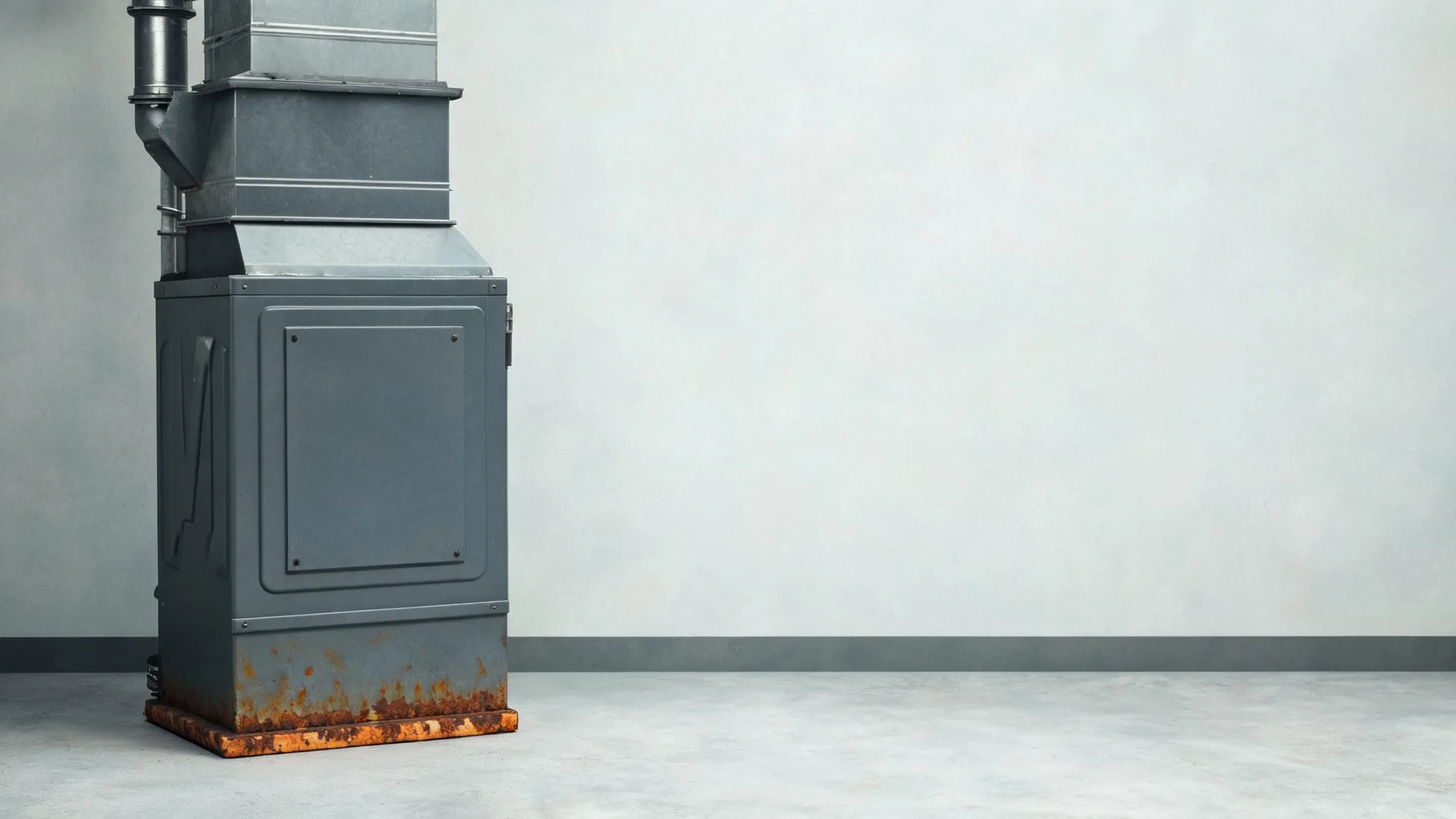
A dirty flame sensor ends in a shutdown

A flame sensor coated in residue reads a weaker signal each time it fires. The furnace is built to shut itself off when it can't confirm a flame, so a furnace left running on a fouled sensor doesn't fail gradually. It short cycles more and more until one day it won't stay lit at all.

A few things are safe to check yourself before calling anyone. Go to the thermostat and make sure it's set to heat, not just fan, and that the setting is a few degrees above room temperature. Check the filter. Pull it out and hold it up to a light. If you can't see light through it, that's choking airflow and may be enough to cause the short cycling on its own. Look at the furnace switch, the one that looks like a light switch, usually near the unit or at the top of the basement stairs, and make sure nothing bumped it off. If the furnace has a window to see the flame, look at the color without taking anything apart. Blue means it's burning right. Yellow or flickering means call someone. Check your breaker panel too. A furnace that won't start at all sometimes just needs a tripped breaker reset, and that's worth ruling out before you assume the worst.

A diagnostic visit starts before any panel comes off. The tech asks what you noticed, when it started, whether it's constant or comes and goes, because that narrows things down fast. Then the cover comes off and they watch it run through a full cycle, ignition to shutdown, since plenty of problems only show up at one point in that sequence. They'll test the flame sensor with a meter rather than just looking at it, check the gas pressure at the valve, and pull the igniter to look for hairline cracks you can't see with it in place. If a heat exchanger is suspected, they'll run a combustion analyzer to check for exhaust leaking where it shouldn't. None of this is guesswork. Each test rules something out or points to the part actually causing the problem, and a tech who skips straight to replacing parts without testing first is just guessing at your expense.