




A flat-roofed adobe-style desert house photographed at twilight, surrounded by saguaro cacti and xeriscape landscaping.

Furnace Maintenance in Fernley, NV

Tell us about the job

Takes about a minute. No obligation.

Tune-up, service, or cleaningFurnace or heatingLyon County, NV
Step 1 of 2

What ZIP code is the job in?

Between visits, the main thing worth doing is checking the filter. A clogged filter starves the furnace of airflow, and that makes the heat exchanger run hotter than it should, which shortens its life. Pull the filter out and hold it up to a light. If you can't see light through it, swap it or clean it, depending on which kind you have. Walk around the house too and make sure nothing is blocking the supply vents or the return. While you're at it, look at the area around the furnace itself and clear away anything stacked near it, since it needs open air to burn safely and vent properly. None of this replaces a real inspection, but it keeps the system breathing right in between.

A gas furnace here only needs a real inspection once a year.

One visit a season catches a cracked exchanger or a bad igniter before Fernley's cold nights find it for you.

Lyon County's weather is hard on equipment. A furnace still only needs looking at once a year.

432 severe weather events from 2015 to 2024
13% of homes statewide lost power a day or more in 2024
305 damaging wind events from 2015 to 2024

Most homes in Lyon County heat with gas, 67.5% of them. That's the majority system here, and a gas furnace has a burner and a flue that an electric furnace doesn't. A yearly check should look at the burner flame, the igniter, and the venting, not just the filter. A cracked heat exchanger or a venting problem can let combustion gases into the house, and you won't see that by looking at the filter. Bottled or LP gas runs on the same principle and needs the same look.

Get the furnace checked in September, before October puts it to work

Furnaces here start working in October and keep at it through May. September is the month before that starts, and it's the right time to get yours checked, while there's still no rush and no cold night waiting on the answer.

Find a contractor
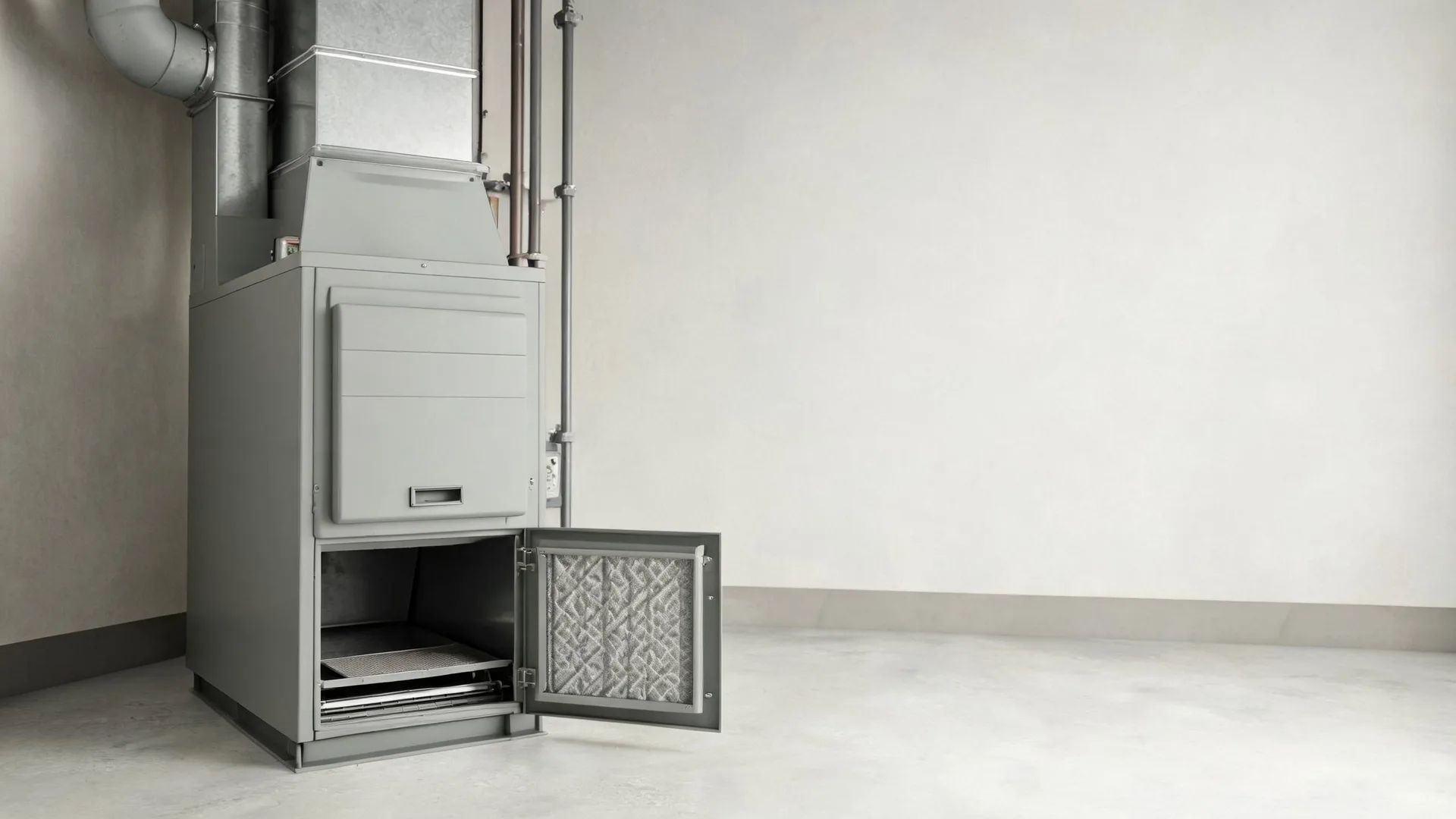
A gray residential gas furnace installed in an unfinished basement, connected to sheet-metal ductwork and PVC pipes.

A newer furnace still needs its yearly look

Half the homes in Lyon County were built in 1998 or later. If yours is one of them, the furnace itself may not be that old either, especially if it's original to the house or a first replacement. A newer furnace still wears with running time, same as any machine, but a yearly check keeps it starting from a good place instead of catching up on neglect. The habit matters more while the system still has most of its working life ahead of it.

What skipping a year actually does

Dust settles on the burner and the blower wheel a little at a time. A dirty burner flame burns uneven instead of steady, and that uneven flame stresses the heat exchanger in spots it wasn't built to take. A blower caked with dust moves less air, so the furnace runs longer to reach the same temperature, and that longer runtime wears the parts that were already weakest.
Why the problem shows up as no heat

A furnace that's been skipped for a while doesn't usually fail gently. An igniter that's been weakening finally stops glowing hot enough to light the gas, or a flame sensor coated in residue tells the furnace to shut off like there's no flame at all. The furnace just stops, on whatever night that part finally gives out. A yearly check is what catches a weak igniter or a dirty sensor while it's still cleaning or a small part, not a cold house.

A furnace doesn't have a drain or coils to worry about. Those belong to the air conditioner side of the same system. But the filter matters to the furnace on its own terms. Airflow across the heat exchanger is what keeps that metal from overheating while the burner fires. Choke that airflow with a dirty filter and the exchanger runs hotter than it was built for, heating up faster than the air moving past it can carry the heat away. Do that winter after winter and you get hairline cracks in a part that was never meant to run that hot. The filter is the simple thing standing between normal operation and that outcome.

A real tune-up is more than a once-over. A tech pulls the burner assembly out and cleans it, because dust and lint settle there just like anywhere else and a dirty burner throws an uneven flame. The flame sensor gets cleaned too, usually with nothing more than a fine abrasive pad, since a thin coat of residue is enough to make it stop sensing the flame at all. The igniter gets inspected for cracks or weak spots, since that part degrades a little every time it fires and gives no warning before it quits. The heat exchanger gets looked at directly, often with a camera, because a crack in it is the one thing a filter and a clean burner can't prevent. The blower wheel gets checked for caked-on dust, since a choked wheel moves less air no matter how clean the filter is. Gas pressure gets tested at the manifold, because too high or too low both stress the burner in ways you can't see from outside the cabinet. And the venting gets checked for blockage or corrosion, since that's what carries combustion gases out of the house instead of into it.