Adobe-style desert homes lit by warm outdoor lighting at dusk, with saguaro cacti in the foreground and a rocky mountain range behind them.

Heat Pump Repair in Virginia City, NV

Tell us about the job

Takes about a minute. No obligation.

RepairHeat PumpStorey County, NV
Step 1 of 2

What ZIP code is the job in?

September is when a weak heat pump shows itself

Heat in Virginia City runs October through May. Once the system has to work every day, whatever was already marginal, a weak capacitor, a low charge, a failing contactor, tends to give out in the first few weeks.

Get it looked at before October

A repair done in September gets ahead of the demand instead of fighting it. Once the cold settles in and the heat pump is running daily, the same problem is harder to diagnose and worse to live with until someone can get to it.

8 months
October through May, your system heats
2 months
July through August, it cools
25°F
the average winter night it heats against
84°F
the average summer afternoon it cools against
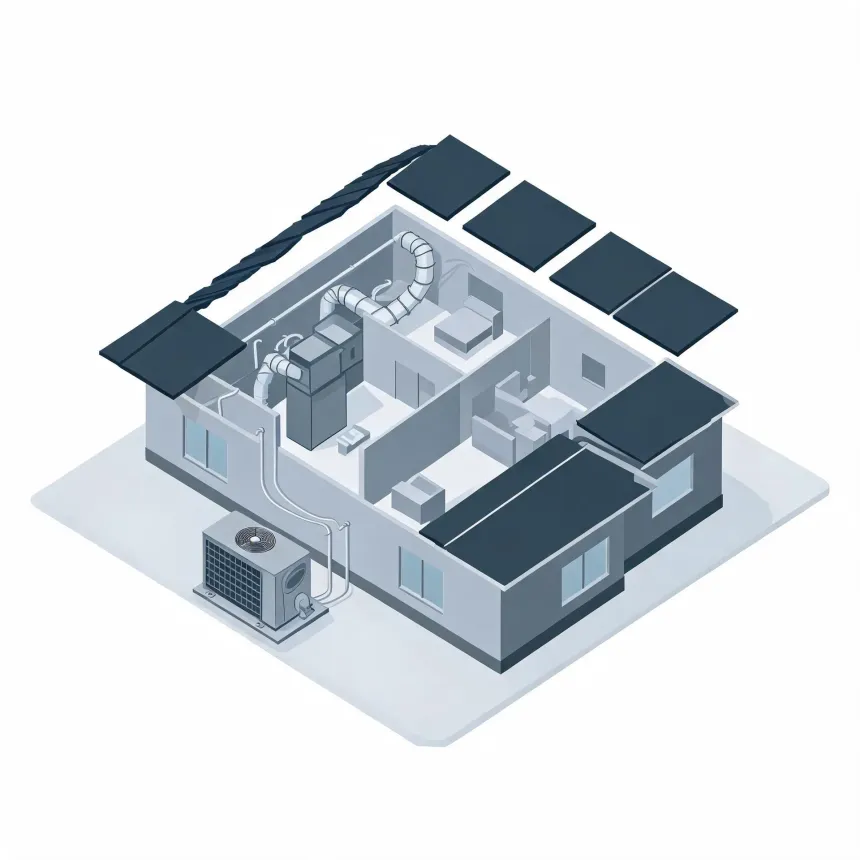
Isometric grayscale illustration of a cutaway single-story house showing interior rooms, ductwork and an air handler, an exterior condenser unit connected by lines, and dark solar panels on the roof.
Your system heats October through May and cools July through August.

NOAA nClimDiv, 1991–2020 normals

Storey County gets damaging wind and winter storms most years, but that's not what wears out a heat pump.

Winter nights here average 25°F, and it's the daily grind of cold that finds the weak part.

Storey County sees its share of wind and winter storms. A heat pump failure here is still most likely the usual part giving out.

299 severe weather events from 2015 to 2024
13% of homes statewide lost power a day or more in 2024
200 damaging wind events from 2015 to 2024
Half of Virginia City's homes are still youngHalf the homes in Storey County were built in 1989 or later.

Nevada homes paid 15 cents per kilowatt-hour in 2024, more than most of the country. A heat pump that's low on charge or running on a weak capacitor draws more power to do the same job, and you pay for that difference every day it runs. Once the cold sets in and this system is running daily instead of cycling on and off, that difference shows up on every bill until the part gets fixed. Getting it looked at now costs less than paying to run it broken all winter.

A newer system is worth repairing

A house built alongside half of Virginia City's homes, in 1989 or later, has a heat pump that's probably not at the end of its life. When a newer system is acting up, the part that failed is worth fixing. Get it diagnosed before the cold settles in.

Find a contractor
A man in a cap, long-sleeve shirt and work pants climbs porch steps toward a dark blue front door, carrying a worn canvas tool bag, with a small potted evergreen beside the entry.
A white mini-split heat pump outdoor unit mounted on a concrete pad beside a gray-sided house, surrounded by gravel and green shrubs.

Your heat pump usually tells you before it quits

A heat pump that's struggling doesn't usually just stop. It tells you first. You'll feel air coming out that isn't quite warm, like it's running but not working. It may run in longer stretches than it used to, or kick on and off more than it should. Ice building up on the outdoor unit beyond what normal defrost cycles clear is another sign, especially if it lingers instead of melting off. Listen for it too. A hum with no airflow behind it points to a seized motor or a bad capacitor. A clicking that repeats without the system starting usually means a failing relay or contactor. Any of these is worth a call before the part that's struggling now quits for good.

The reversing valve is usually the first thing to go

A heat pump switches between heating and cooling with a reversing valve, and that part works harder and more often than almost anything else in the system. A valve that's stuck or leaking refrigerant past it can leave you with heat that doesn't feel warm, or a system stuck in one mode.

The outdoor unit takes the abuse

The outdoor coil and fan sit outside year round, and that's where failure tends to start. A coil caked with debris can't give up heat the way it needs to, and a motor or capacitor out there wears from running through every defrost cycle the system goes through all winter.

A heat pump that's struggling still moves heat, just not enough of it, so the house doesn't feel the loss right away. That's what makes it easy to let ride. A weak capacitor makes the compressor pull harder every time it starts, and a motor running on a failing bearing keeps drawing power right up until it seizes. Refrigerant leaking past a bad reversing valve doesn't stop the system, it just makes it run longer to do the same job. None of that fixes itself by waiting. The part that's struggling now is the part that quits later, usually on the coldest night it's asked to work the hardest.

A diagnostic visit starts with the complaint, not the equipment. A contractor wants to know what you noticed first, when it started, and whether it's gotten worse, because that narrows things down before a single panel comes off. From there it's gauges and a meter. Refrigerant pressure tells you if the charge is right or if there's a leak past the reversing valve. A meter on the capacitor and the contactor shows whether they're holding their rated values or drifting toward failure. The outdoor unit gets checked for ice, for a coil clogged with debris, for a fan motor that's loud or slow to start. None of this takes guesswork once the readings are in front of someone who knows what they should say. The visit ends with a part named, not a guess.