View from under a dark wooden patio roof across a gravel yard toward a stucco house wing, a low concrete block wall, and a large gnarled tree.

Heat Pump Repair in Lovelock, NV

Tell us about the job

Takes about a minute. No obligation.

RepairHeat PumpPershing County, NV
Step 1 of 2

What ZIP code is the job in?

The tech checks the whole system, not just the symptom

A heat pump that won't heat might have a problem in the outdoor unit, the indoor coil, the refrigerant charge or the control board. The tech will check pressures, measure the temperature split across the coil, and test the reversing valve before deciding what's actually wrong. A unit that's low on refrigerant looks a lot like a failing compressor from the thermostat, but the fix is completely different.


What they find decides whether it's worth repairing

A bad capacitor or a stuck reversing valve is a straightforward fix on a system that's otherwise sound. A compressor on its way out, or a coil that's corroded through, is a different conversation, especially on an older unit. The diagnosis tells you which kind of problem you have before any money gets spent on parts.

8 months
October through May, your system heats
3 months
June through August, it cools
23°F
the average winter night it heats against
88°F
the average summer afternoon it cools against
Isometric line illustration of a cutaway single-story house showing interior ductwork, an indoor air handler unit, and an outdoor condenser connected by refrigerant lines, with a dark shingled roof.
Your system heats October through May and cools June through August.

NOAA nClimDiv, 1991–2020 normals

Heat pumps in Lovelock sit mostly idle in September.

October is when a weak part under real load finally gives out.

At 15 cents a kilowatt-hour, a heat pump working harder than it should shows up on the bill fast

Power costs 15 cents a kWh statewide
53 damaging wind events from 2015 to 2024
10 winter storms from 2015 to 2024
Nothing unusual here, just the usual fixHalf the homes in Pershing County were built in 1984 or earlier. That doesn't make a heat pump here any more likely to fail.

Your heat pump isn't fighting much here. Winter lows average 23°F, not the single-digit cold that pushes a compressor hard, and Pershing County sees heavy snow or ice about once a year. Wind is the more frequent event, 53 times over the last ten years, but that's hard on loose panels and outdoor unit mounts, not on the compressor itself. So if your system is acting up, the cause is more likely a worn part or a few years of neglect than years of hard running. That's the kind of problem that's usually worth fixing.

A heat pump running wrong still runs up your bill

A bad capacitor or a stuck reversing valve keeps pulling power at 15 cents a kilowatt-hour whether it's fixing anything or not. The longer it sits, the more that part costs you on top of whatever it takes to replace it. Have it looked at.

Find a contractor
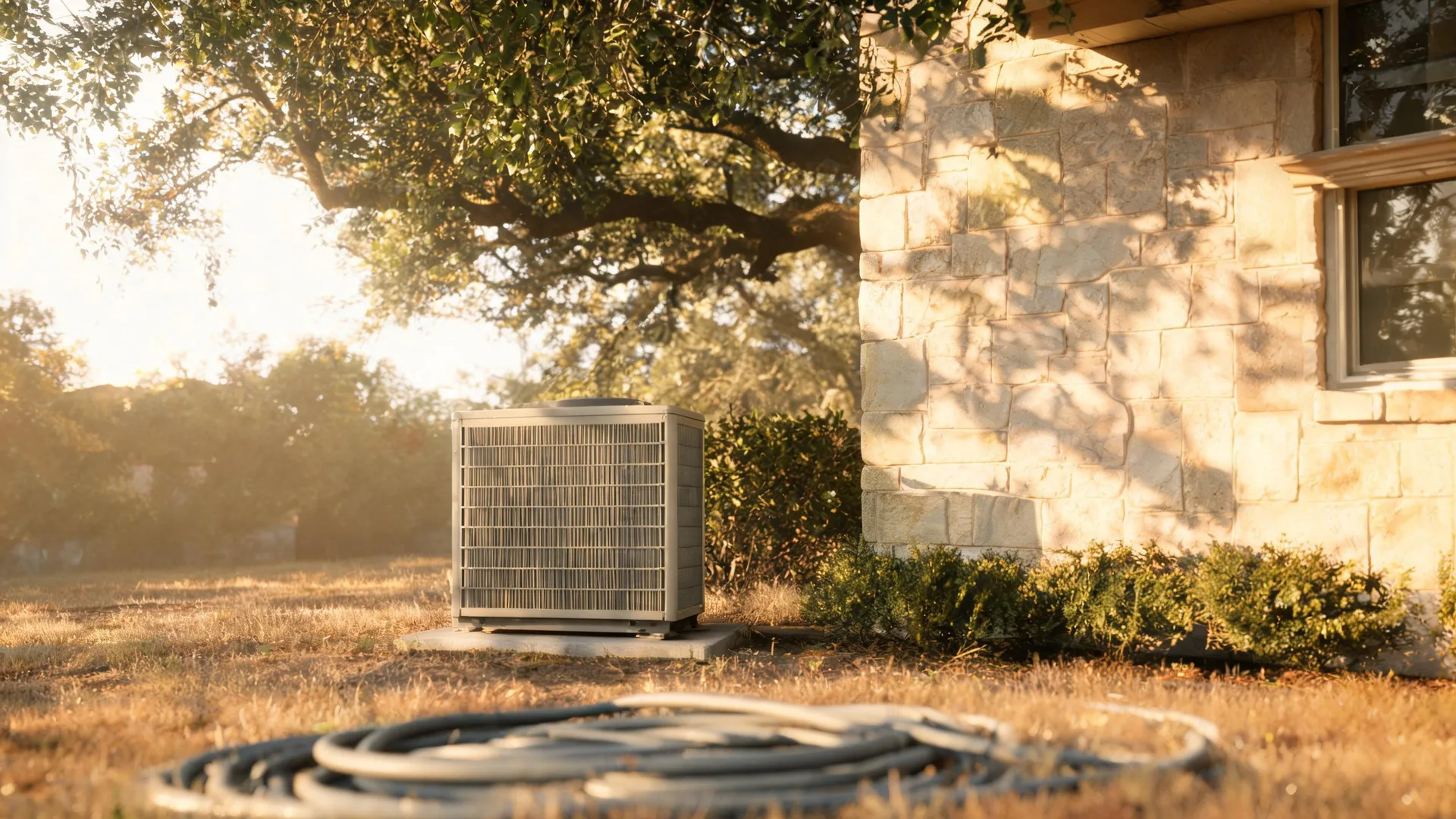
A gray heat pump condenser unit mounted on a concrete pad against the gray lap-siding exterior wall of a house.

What to check before you call

Before anyone comes out, there are a few things worth looking at yourself. Check the thermostat is set to heat and the temperature is actually set above room temp, not just on auto. Go outside and look at the outdoor unit. If it's covered in ice, that's not always a problem by itself, heat pumps defrost periodically, but if the whole unit is a solid block, something's wrong. Make sure nothing is blocking the airflow around it, no leaves, no snow drift, no stored patio furniture pushed up against the coil. Inside, check the air filter. A filter clogged with dust chokes airflow across the indoor coil, and that alone can make a heat pump blow cool air or trip off on its own. Walk around to each vent and feel whether air is actually moving. If one room is cold and the rest are fine, that points to ductwork, not the heat pump itself. Check your breaker panel too. Heat pumps run on a dedicated circuit, and a tripped breaker will shut the whole system down without any other warning. None of this fixes a bad compressor or a stuck reversing valve, but it rules out the simple stuff before anyone takes the panels off.

Most failures start outside

The outdoor unit takes the weather, so that's where trouble usually starts. A run capacitor weakens over time and stops giving the compressor and fan motor the jolt they need to start. Contactors pit and stick from years of opening and closing. Dirt and debris packed against the outdoor coil block airflow until the system overheats and shuts itself down.

The reversing valve is the heat pump's weak point

A furnace never has to decide which direction to move heat. A heat pump does, and that job falls to the reversing valve. When its coil burns out or the valve itself sticks, the system stops switching into heat mode and blows cold air instead. It's one of the few parts unique to a heat pump, and one of the more common reasons for a no-heat call.

A heat pump in trouble usually tells on itself in small ways before it quits outright. It might run longer than it used to, cycling on and on without the house ever feeling warm. It might blow air that's room temperature instead of warm, which points to the reversing valve or the compressor rather than anything you can fix by cleaning a filter. Listen for new noises too. A hard clank at startup is often the contactor. A hum with no fan movement usually means the capacitor's given out. Ice that builds up on the outdoor unit and never clears on its own, even after the system has had time to defrost, means something in that cycle has failed. Short cycling, where the unit switches on and off every few minutes instead of running a full cycle, wears the compressor faster the longer it goes unchecked.

A repair tech can fix almost anything on a heat pump. The question is whether it's worth doing. A capacitor, a contactor, a reversing valve, these are parts that get replaced on their own, and once that's done the system runs like it used to. A compressor is different. It sits inside a sealed system, and when it's failing the labor to get at it starts to rival putting in a new unit entirely. Age matters here too, not because a number on a calendar means anything by itself, but because a unit near the end of its working life rarely fails in just one place. Fix the capacitor this year and the coil may go next year. That pattern, more than any single part, is what tips the decision toward replacing rather than repairing again.