






Three adobe-style desert homes with warm landscape lighting, surrounded by saguaro cacti and desert vegetation under a deep blue dusk sky.

Heat Pump Repair in Hawthorne, NV

Tell us about the job

Takes about a minute. No obligation.

RepairHeat PumpMineral County, NV
Step 1 of 2

What ZIP code is the job in?

A tech starts outside at the outdoor unit, checking refrigerant pressures and seeing whether the compressor and fan are running the way they should. Frost on the coil in a spot it shouldn't be, or no frost where there should be some, points toward a charge problem or a failing reversing valve. Inside, they'll check the air handler, the condition of the filter, and whether the system is actually putting out warm air or just blowing. A heat pump that runs constantly without reaching the set temperature often has a problem with the reversing valve, which is what lets it switch between heating and cooling. If the outdoor coil stays iced over, that usually points to the defrost control board or a sensor telling it the wrong thing. Once the tech finds the cause, they'll explain what's failing and what it takes to fix it before doing any work.

8 months
October through May, your system heats
2 months
July through August, it cools
22°F
the average winter night it heats against
86°F
the average summer afternoon it cools against
Isometric cutaway illustration of a small house showing interior ductwork and an air handler connected by lines to an outdoor condenser unit on a pad beside the building.
Your system heats October through May and cools July through August.

NOAA nClimDiv, 1991–2020 normals

Winter nights here average 22°F, and that's not extreme cold for a heat pump to handle.

A Hawthorne unit acting up is more likely dealing with a worn part than a system that's been pushed past its limits.

At 15 cents a kilowatt-hour, a heat pump working harder than it should costs you every month it runs that way

Power costs 15 cents a kWh statewide
61 damaging wind events from 2015 to 2024
17 winter storms from 2015 to 2024
Hawthorne's homes are older than mostHalf the homes in Mineral County were built in 1971 or earlier, and a heat pump that old is running on borrowed time.

If a Hawthorne heat pump is acting up, that's worth a repair call before a replacement call. The cold here isn't pushing the system hard, so a breakdown is more likely one worn part than a unit that's used up. Wind is the harder weather on this machine. Damaging gusts have hit Mineral County 61 times between 2015 and 2024, enough to knock an outdoor unit's cabinet out of alignment or work a refrigerant line fitting loose over the years. That kind of damage shows up as a specific problem a tech can find and fix, not as a system past saving.

It's usually worth repairing

It has an easier job here than in most places, so your heat pump is often in decent shape. Repair is usually worth it.

Find a contractor
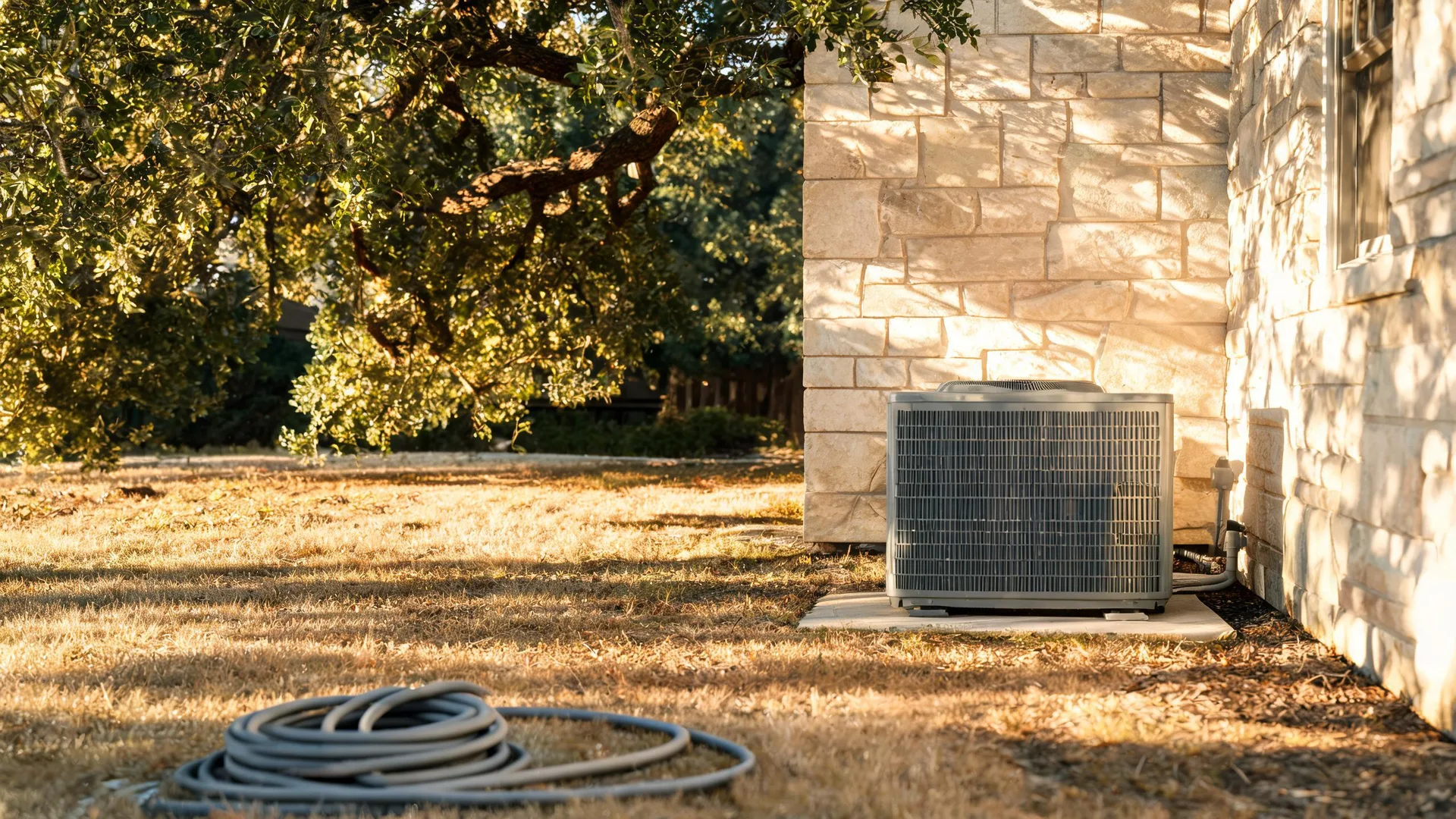
A gray heat pump outdoor unit mounted on a concrete pad next to a residential house with lap siding and stone accents.

Ask what's left in it before you fix it

If the heat pump outside is original to the house, ask the tech how many years it's got left before putting money into this repair. Half the homes in Mineral County were built in 1971 or earlier, and a unit that's sat in a house that long has likely been replaced once already, maybe more. Knowing where the current one stands tells you whether this repair is the last one or just the next one.

The capacitor and the contactor wear out first

The run capacitor gives the compressor and fan motor the jolt they need to start, and it weakens over years of heat cycles until the outdoor unit hums but won't start, or the fan stalls. The contactor is the switch that sends power to the outdoor unit, and its contacts pit and burn with every cycle until they stop closing reliably. Both are common reasons a heat pump just stops responding, long before the compressor itself is the problem.
Low refrigerant means a leak, not a top-off

A heat pump doesn't use up refrigerant the way a car uses gas. If the charge is low, it's leaking out somewhere, usually at a fitting, a coil, or a line that's been rubbed thin. Adding refrigerant without finding the leak just means doing it again later. The reversing valve and defrost sensors depend on correct pressure to work right, so a slow leak can show up first as weak heating rather than as an obvious fault.

Most calls start with something simple. The system is running but the air coming out doesn't feel warm, or it feels barely warm at all. Sometimes it short cycles, kicking on and off every few minutes instead of running a steady stretch. Sometimes it won't switch over from cooling to heating, or it gets stuck in defrost and never comes back out. A clicking sound when it tries to start and fails is usually the contactor or capacitor giving up. A hissing or bubbling sound near the lines can mean refrigerant escaping somewhere it shouldn't. None of these mean the unit is finished. They mean a specific part is done doing its job, and until that part is replaced, the rest of the system is working harder to make up for it.

A good rule to go by. If the compressor is still sound, almost everything else on a heat pump can be replaced on its own. The compressor is the expensive part and the hardest to get to. It's sealed inside the outdoor unit, doing the real work of moving heat. A capacitor, a contactor, a defrost board, even a reversing valve are all things a tech can swap without touching the compressor, and doing so brings the whole system back to normal. What changes the math is a compressor that's failing, or a leak severe enough that the system has run low on charge for a long stretch, since running low stresses the compressor every time it starts. Ask the tech directly which part is bad. If it's anything other than the compressor, fixing it is usually the straightforward choice.