View from beneath a concrete overhang across a gravel yard toward a single-story stucco building with square columns, a gray concrete block wall, and a large bare-branched tree at right.

Heat Pump Repair in Crescent Valley, NV

Tell us about the job

Takes about a minute. No obligation.

RepairHeat PumpEureka County, NV
Step 1 of 2

What ZIP code is the job in?

August is when a weak heat pump shows itself

Heat in Crescent Valley runs from September through June, nearly ten months straight. When a heat pump switches over after sitting idle through the summer, whatever was already marginal in it tends to fail first. A worn contactor or a low-charge system that limped through July cooling often won't make it through the first cold week.


Get it looked at before September

A repair called in August, before the switchover, gets diagnosed without the pressure of a cold house. Once heat season starts, the same unit is running almost every day through next summer, so a problem caught now is one less call during the months the system can't be down.

10 months
September through June, your system heats
2 months
July through August, it cools
18°F
the average winter night it heats against
84°F
the average summer afternoon it cools against
Isometric illustration of a cutaway single-story house showing interior ductwork and an air handler connected by lines to an outdoor condenser unit on a pad beside the building.
Your system heats September through June and cools July through August.

NOAA nClimDiv, 1991–2020 normals

Winter storms hit Eureka County 101 times between 2015 and 2024, but a heat pump outside sits through cold and wind, not under falling ice.

A unit that hasn't been battered by hail or storm damage is usually sound underneath, so a repair now is more likely to hold.

Crescent Valley doesn't put extra strain on a heat pump

203 severe weather events from 2015 to 2024
13% of homes statewide lost power a day or more in 2024
97 damaging wind events from 2015 to 2024
Power here costs more, so a bad heat pump costs moreNevada homes paid 15 cents per kilowatt-hour in 2024

Half the homes in Eureka County were built in 1988 or earlier, and half in 1988 or later. That split doesn't point to any one cause of a heat pump failure here. More than half the housing in this county is mobile homes, and that's worth a contractor knowing before they show up, since the line set and pad on a mobile home are often laid out differently than on a site-built house. It changes how a problem gets traced, not what the problem is. A contactor, a capacitor, a low charge still fail the same way whether the unit sits on a mobile home or a foundation.

A heat pump here is usually worth repairing

Repair here isn't a gamble against the odds. The unit's been sitting through cold and wind, not getting battered by hail or storm debris, so whatever's wrong is likely the part itself, not something storm damage set in motion. That's a straightforward fix to call in.

Find a contractor
A man in a cap, olive shirt and dark pants carries a canvas tool bag up concrete steps toward a dark blue front door, with a potted shrub beside the entry.
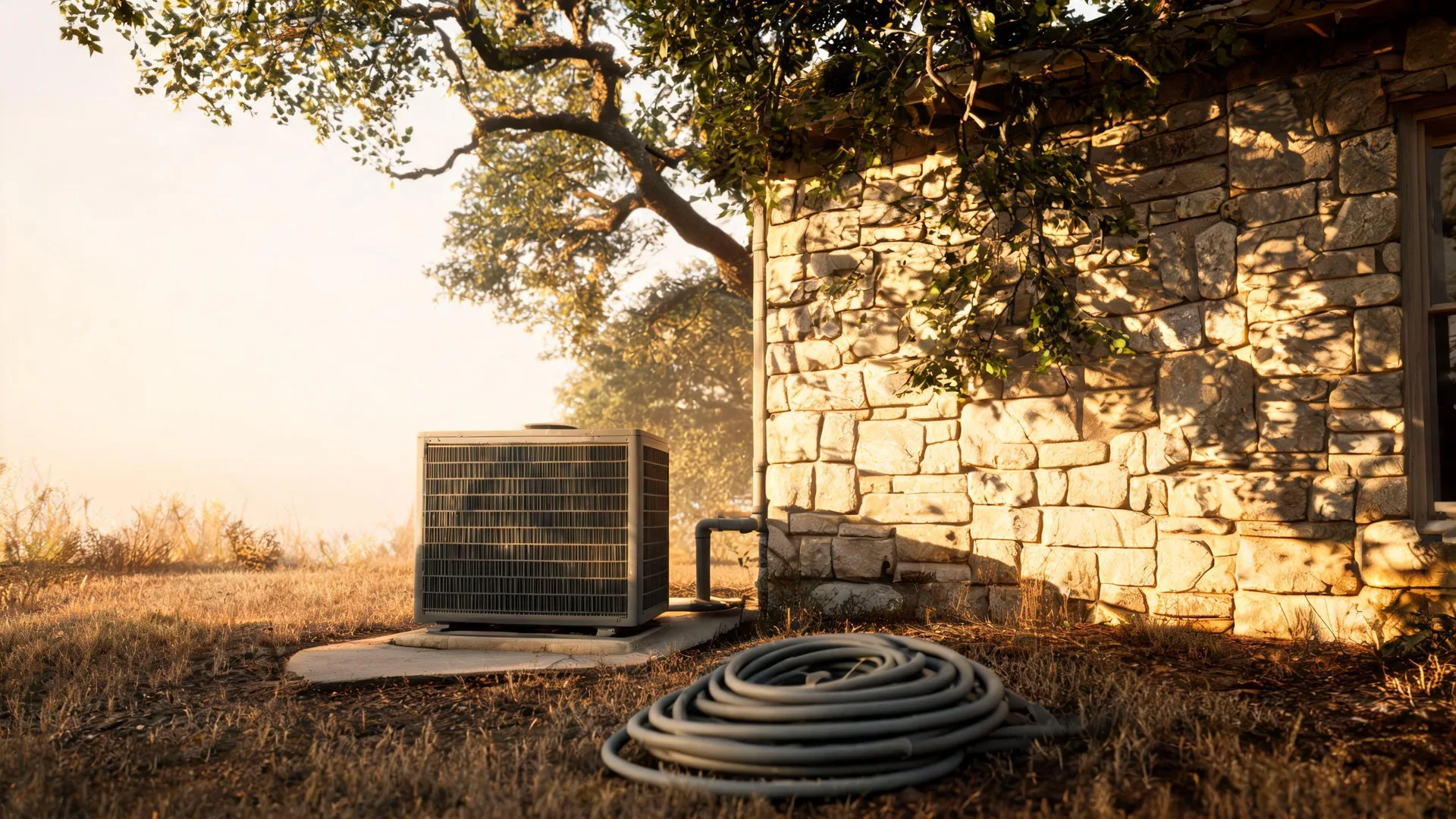
A gray heat pump outdoor unit mounted on a concrete pad next to the stone-accented exterior wall of a house.

A heat pump works all year, and fails where that shows

A heat pump runs the compressor for both heat and cooling, so it logs far more hours than a unit that only cools. That extra runtime wears the same parts faster. The contactor pits and sticks from constant cycling until it stops making contact. The capacitor loses its charge over time and stops kicking the compressor on when it should. Refrigerant seeps out slowly at a fitting or coil joint, and a system running low makes the compressor strain until something gives. The reversing valve, which only a heat pump has, can stick after years of switching between heat and cool, so the system keeps blowing the wrong temperature no matter what the thermostat says. None of this comes from one bad day. It comes from a unit that never really gets the off season a straight air conditioner gets.

Most failures are one part, not the whole unit

A heat pump that trips the breaker, runs constantly, or blows the wrong temperature is usually down to a single failed part. A stuck reversing valve, a failed capacitor, a contactor that won't close, a low charge from a slow leak. Each of these has a clear fix on its own and doesn't mean the compressor or the rest of the system is going with it.

Age on the compressor is what changes the math

A repair is worth doing when the unit is sound apart from the failed part. The question to ask is how the compressor itself is running, since that's the part that's expensive to replace and impossible to patch. If it's still pulling steady current and holding pressure, fixing what broke makes sense. If the compressor is the thing failing, replacing the one part doesn't buy much time.

Most heat pump trouble shows up as something the system is doing wrong, not a smell or a sound. It blows air that's not warm enough, or not cold enough, and the thermostat setting doesn't change that. It runs and runs without ever shutting off, trying to reach a setpoint it can't hit. Outside, the unit ices over in a way that doesn't clear on its own, which usually points to the defrost cycle not kicking in or the reversing valve not switching like it should. A clicking sound when it tries to start and doesn't catch is usually the contactor or capacitor giving out. If the breaker trips more than once, stop resetting it and get it looked at, since that's the system telling you something downstream is drawing more current than it should.

A diagnostic visit starts with the thermostat and works outward. A tech will check what it's calling for against what the unit is actually doing, heat, cool, or neither. From there it's gauges on the line set to read pressure, and a meter on the contactor and capacitor to see if they're holding charge and making contact like they should. Amp draw on the compressor tells its own story, since a compressor pulling too much current is already in trouble even if it's still running. Outside, the coil gets a look for ice or damage, and the reversing valve gets tested by forcing a switch between heat and cool to see if it actually responds. Most of this takes less time than people expect, because a failed part usually shows itself clearly once the right test is run.