







An outdoor heat pump unit mounted on a concrete pad beside a house with beige siding and a landscaped garden bed.

Heat Pump Installation in Ely, NV

Tell us about the job

Takes about a minute. No obligation.

New system or replacementHeat PumpWhite Pine County, NV
Step 1 of 2

What ZIP code is the job in?

Nevada power runs 15 cents a kilowatt-hour. A heat pump moves heat instead of burning gas to make it, so it gets more warmth out of every watt it pulls off the grid. That matters more here than somewhere with cheap power, because every inefficient hour costs you more in Ely than it would across the state line. The efficiency rating on the unit you install is what decides whether this bill works for you through the winter and into the summer cooling months. A higher-rated system costs more going in, but it's drawing on the same 15 cent power the whole time it runs.

10 months
September through June, your system heats
2 months
July through August, it cools
17°F
the average winter night it heats against
82°F
the average summer afternoon it cools against
Isometric line illustration of a cutaway house showing interior rooms with furniture, ceiling ductwork under a dark shingled roof, and an outdoor condenser unit connected by lines on the right.
Your system heats September through June and cools July through August.

NOAA nClimDiv, 1991–2020 normals

Half the homes in White Pine County were built in 1970 or earlier.

An older house needs a load calculation, not just a swap for what's there now.

Weather here is rough on a system. The system itself doesn't need to be oversized for it.

475 severe weather events from 2015 to 2024
13% of homes statewide lost power a day or more in 2024
246 damaging wind events from 2015 to 2024
Built for Ely, not oversized for itWinters here average 17°F overnight, and that's a job for a correctly sized heat pump, not a bigger one.

White Pine County is zone 5B, a cool zone where the furnace side of the system carries more of the year's work than the air conditioner side. Any heat pump installed here new has to clear 7.5 HSPF2 for heating and 14.3 SEER2 for cooling, the federal minimum since January 2023. Those numbers set a floor, not a target. A contractor sizing your system for this zone is already working above that floor, because a unit rated right at the minimum is the least efficient one still legal to install. The same federal rule sets a cooling-only minimum for this region too, so whatever goes in has to clear both sides, not just the one you'll lean on more.

Electric heat is already the norm here

Electricity heats 64.5% of the homes in White Pine County, more than any other fuel. A heat pump works with that wiring already in place, no gas line to run, no new fuel service to set up. It handles the cooling side too, so one system covers both jobs on the power you're already wired for.

Find a contractor
A man in a cap, gray long-sleeve shirt and tan work pants climbs porch steps toward a dark blue front door, carrying a canvas tool bag with tools in its outer pockets.
A gray heat pump outdoor unit mounted on a concrete pad next to a residential house with lap siding and stone accents.

Ten months of heat a year means timing the install matters

Heat runs here from September through June, about ten months a year. Cooling covers the other two, July and August. With heat carrying that much of the year, the system spends most of its life in heating mode, so that side of the install is worth getting right. August is the month before cooling starts, and June is the month before heat starts, either one gives a contractor room to size the load correctly instead of rushing it in during a cold snap or a heat wave.

The ductwork decides more than the unit does

If the ducts already in the house are undersized or leaky, a contractor has to fix or replace sections before the heat pump can move enough air. That work varies house to house, and it's often a bigger factor in the final price than the equipment itself. A system that's right for the job but feeding bad ductwork won't heat or cool the way it's rated to.
Where the unit sits adds its own cost

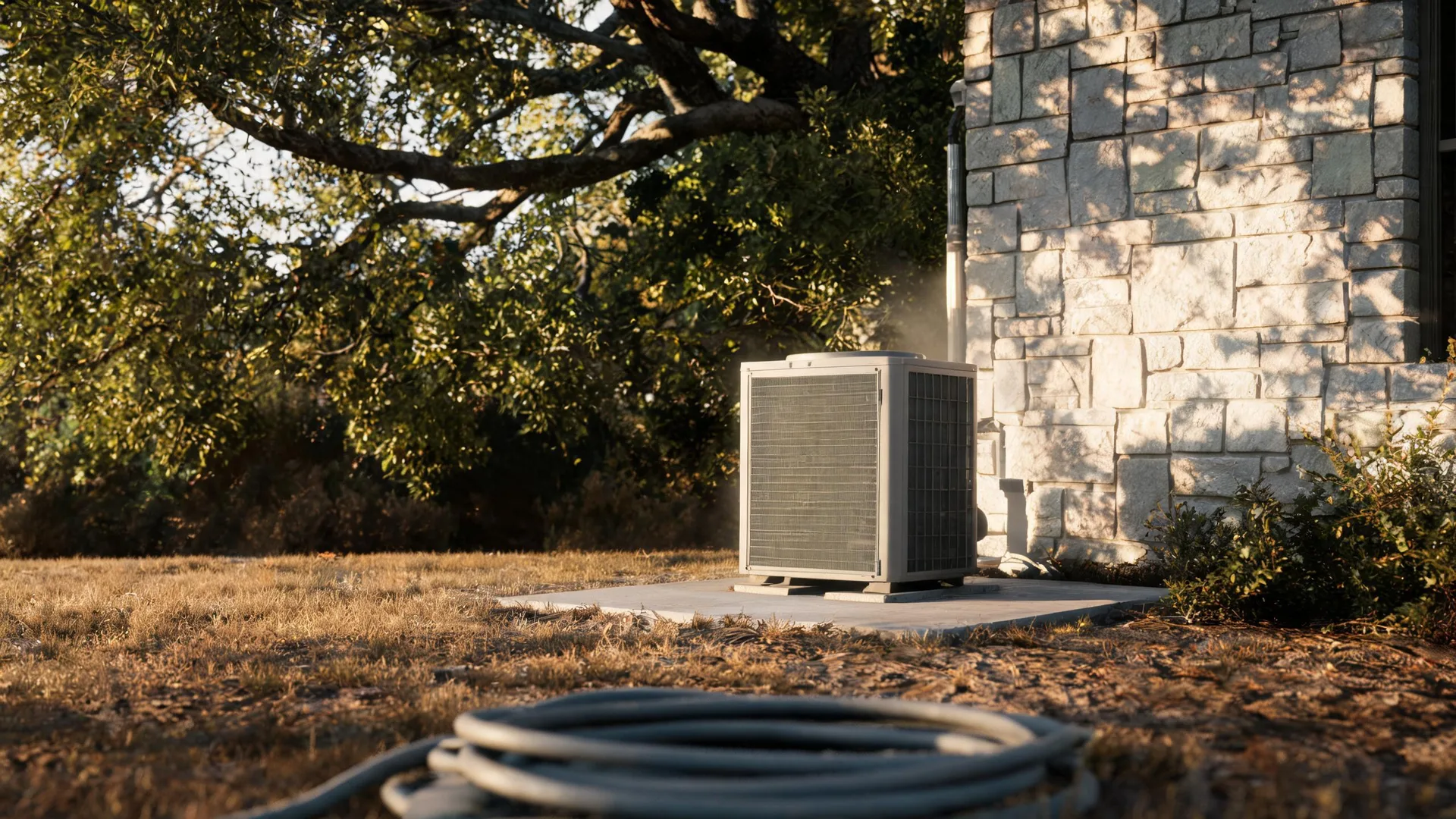
A heat pump needs clear airflow on all sides of the outdoor unit and a spot that drains properly, since it collects condensation and sheds frost in defrost cycles. Setting a pad, running new line sets, or relocating the unit away from where the old equipment sat all take extra labor. The straighter the swap, the less there is to build around it.

Ask for the manual J load calculation itself, not just the number it spits out. A contractor should be able to show the room by room heat loss and heat gain, not just a single tonnage figure. Ask what happens below freezing. Every heat pump loses capacity as the outdoor air gets colder, and the question is what carries the house when the unit can't keep up on its own. Some systems answer that with electric resistance backup built into the air handler, others lean on a furnace already in place. Ask how the installer sized the backup, not just the heat pump. An undersized backup heater runs constantly on the coldest nights, and an oversized one cycles on and off more than it should. Ask what the sound rating is for the outdoor unit too, since it runs through the winter near a wall or a window, not just in summer.

Taking out the old system is its own job, separate from putting in the new one. If the house ran on a furnace, the old gas line gets capped off and the vent that carried exhaust out through the wall or roof gets sealed, not just left open behind the siding. If refrigerant is still in the old coil or condenser, it has to be recovered into a tank rather than vented off, that's federal law, not a courtesy. The old outdoor unit comes off its pad, and the pad itself either gets reused or broken up, depending on whether the new unit sits in the same spot. Old line sets running between the indoor and outdoor units usually come out too rather than get reused, since they're sized for the old system's refrigerant charge, not the new one. None of this is hard labor, but it's labor, and it has to happen before the new equipment goes in, not around it.